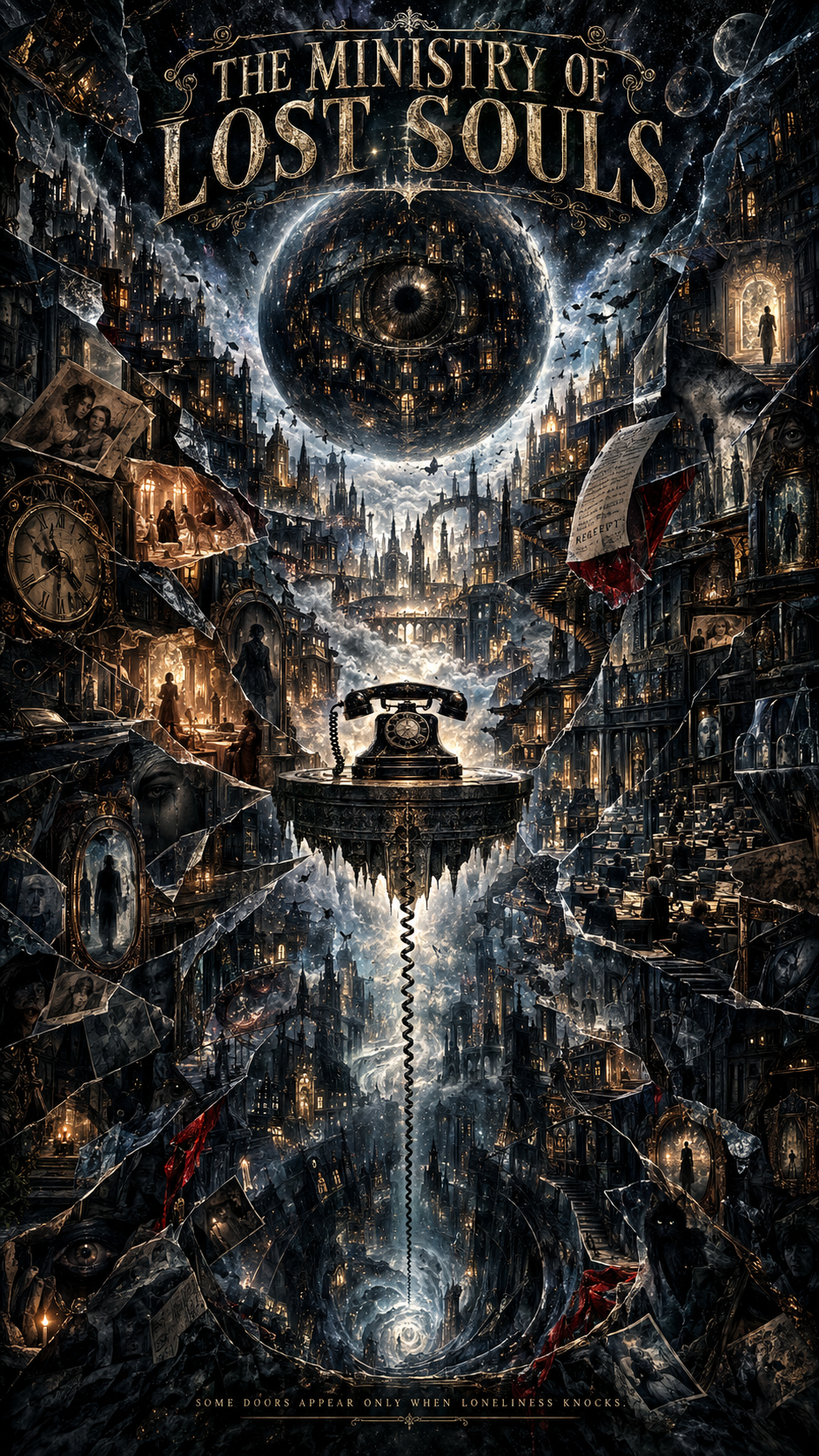
THE MINISTRY OF LOST SOULS
Gothic psychological horror · Dark cinematic fiction
Recovered from an abandoned office beneath a city that does not appear on any map.
PROLOGUE: A MOST UNFORTUNATE AGE
There are places that do not exist.
Not on maps. Not in memory.
Not in any record the living are permitted to keep.
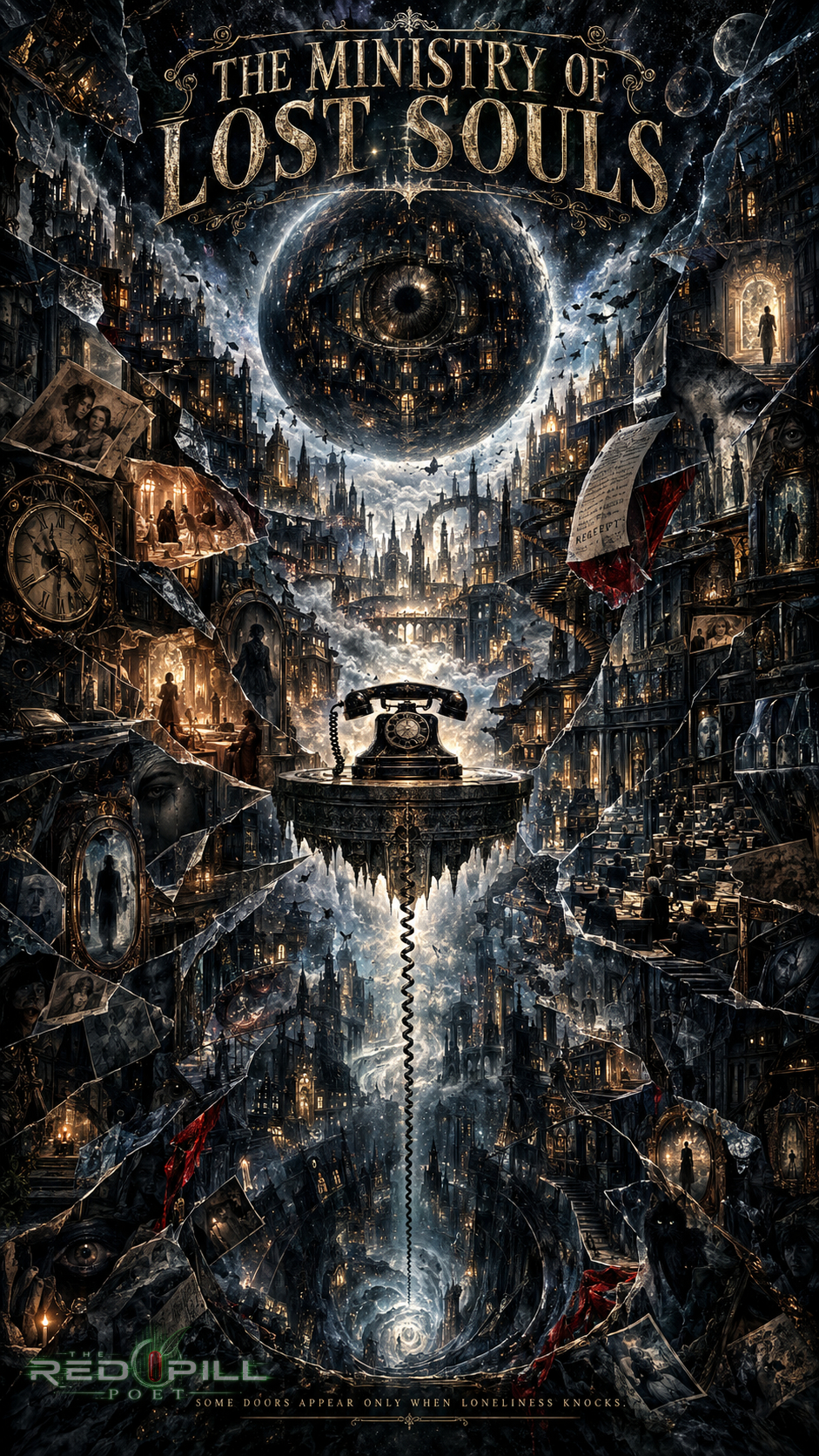
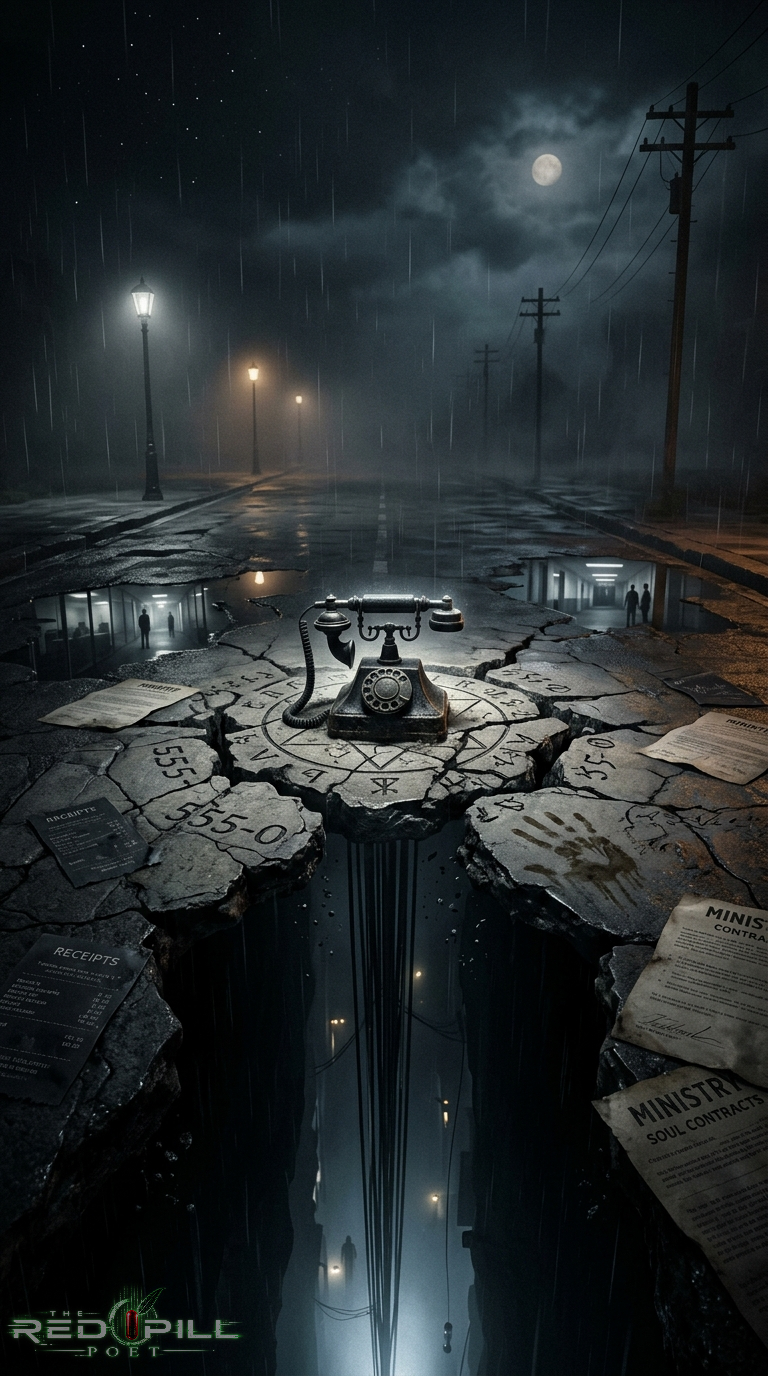
And yet, on certain nights, when the rain falls upwards and the moon hangs low enough to touch, you may hear a telephone ringing beneath the pavement.
Do not kneel to listen.
Do not press your ear against the stones.
And whatever you do, do not call out to ask who’s there.
For the last person who answered that telephone is still trying to hang up.
Should you answer it, a voice will ask you something very simple.
Are you happy with your life?
Do not answer.
For something on the other end is listening.
And it has been listening for a very, very long time.
I. THE PRICE OF BEING ALIVE
I was born in an age of wonderful things.
We put the world inside our pockets. We made the stars into numbers. We taught our mirrors how to speak and gave our loneliness a name.
We built a thousand roads to one another and wondered why we felt alone.
We filled our homes with little glowing windows, watched strangers laugh, watched strangers bleed, watched strangers beg the world to see them.
And somewhere in the endless scroll, between a child’s birthday and a war without an ending, an advertisement whispered:
You deserve better.
Of course we did.
The rent was due. The cupboard was bare. The landlord was coming. The medicine cost more than the meal.
A man slept beneath a shopfront where the wealthy bought their dreams. The council came at half past six to fine him for the space he’d claimed.
They tore the shelter from the ground and called the pavement clean.
A butcher gave the hungry hot food. A court declared what kindness cost.
And somewhere, in a tower of glass, a man who’d never missed a meal calculated what the hungry were worth.
I watched a mother count her coins beneath a flickering light. She put the bread back on the shelf and told her child she’d eaten twice.
I watched a worker lose his hands to forty years of honest toil, then lose the home he’d laboured for because his broken body could no longer earn.
And all the while, the billboards smiled.
Your future is looking bright.
Your suffering is temporary.
Your data helps us serve you better.
I began to wonder, in those days, whether the devil had grown tired of souls.
Perhaps he’d found a cheaper way.
Perhaps he’d learned to leave the body breathing while he quietly took the life away.
II. THE LETTER
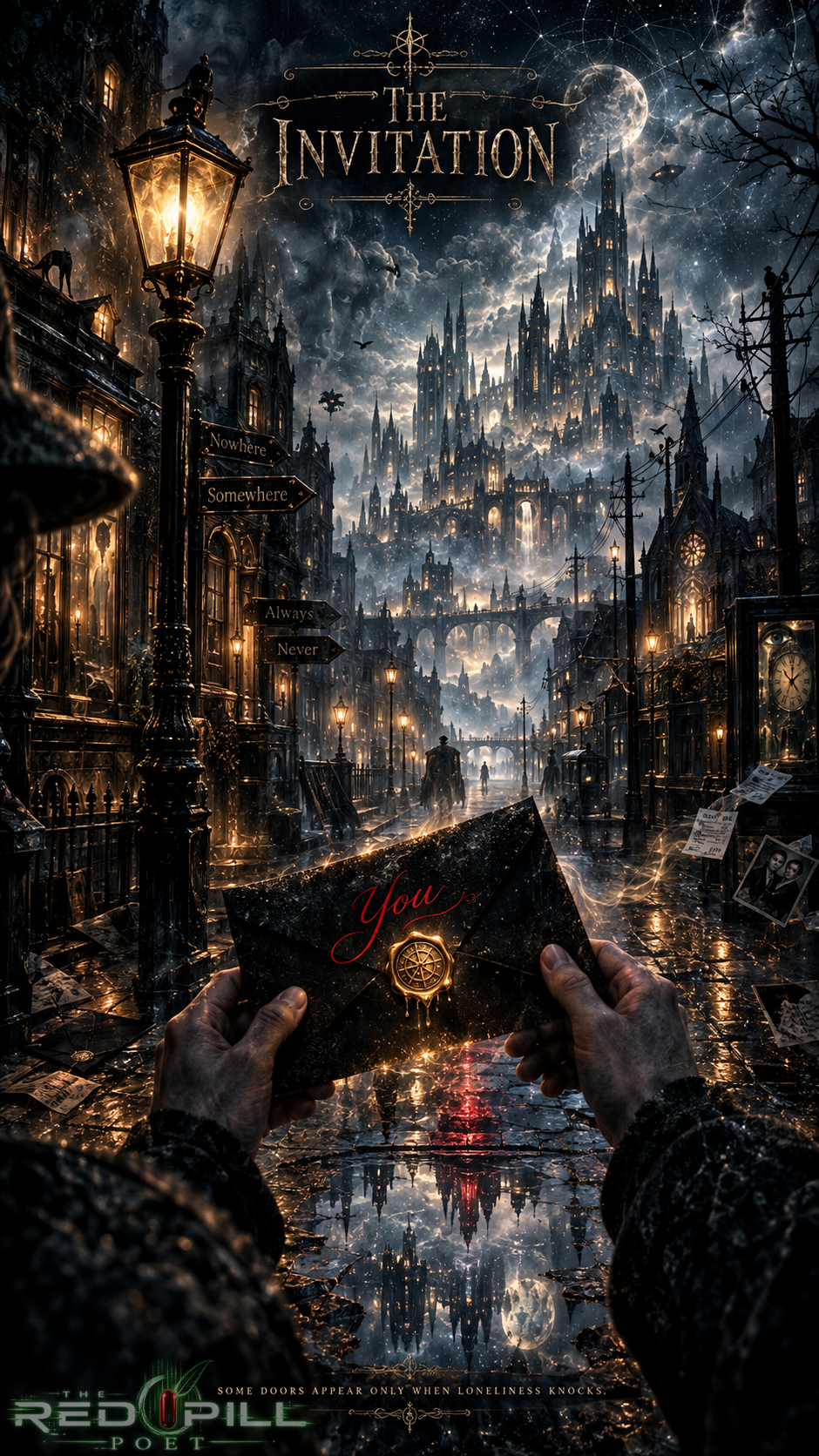
The letter came on a Thursday.
No stamp.
No seal.
No name.
Just a sheet of yellowed paper folded neatly in a frame of blackened lace.
Upon it, in a hand that looked remarkably like mine, were seven words:
WE UNDERSTAND YOU’VE HAD A DIFFICULT TIME.
Beneath them, a telephone number.
And underneath that:
The Ministry of Lost Souls.
We regret your circumstances.
We can offer you a better world.
I should have burned the letter.
I should have thrown it in the river, watched the ink dissolve, and gone about my life.
But my mother had been dead for seven years.
And there, beneath the Ministry’s address, was a sentence that made my blood run cold.
She would like to speak with you.
I called.
A woman answered in a voice as soft as dust upon a grave.
“Good evening, sir. We’re terribly sorry for your loss.”
I could not speak.
“We know,” she continued, “that certain absences can become unbearable.”
I gripped the receiver.
“We cannot restore what has been taken. But we can offer you something very close.”
There was a pause.
Then she asked:
“Would you like to see your mother again?”
I said yes.
God help me.
I said yes.
III. THE OTHER WORLD
The door appeared inside my bedroom wall.
It had not been there before.
A little black handle. A keyhole shaped like an eye. And from somewhere on the other side,
the smell of my childhood home.
I turned the handle.
And there she was.
My mother, standing in the kitchen, with sunlight in her hair and flour upon her hands.
The radio played the song she used to hum. The kettle sang. The old clock ticked.
She looked at me.
She smiled.
“Oh, darling. You’ve grown so thin.”
I fell into her arms.
And for the first time in seven years, I was no longer a man who had learned to live with loss.
I was a child.
I was home.
She made the soup I loved. She sat beside my bed. She brushed the hair back from my forehead and told me I could rest.
And when I cried, she held me tighter.
No bills upon the table. No funeral in the rain. No final hospital telephone call replaying in my brain.
Just warmth.
Just love.
Just the impossible mercy of having one more day.
I did not ask how she had returned.
I did not ask why the birds outside all sang the same three notes.
I did not ask why the clock hands never moved beyond eleven.
I had spent seven years learning that the world did not care.
And here was a world that did.
So when my mother took my face in her hands and whispered,
“Stay with me, darling. There’s nothing out there for you.”
I promised that I would.
Of course I promised.
What would you have done?
Tell me.
What would you have done if the dead had opened their arms and the living had only ever opened bills?
IV. THE TERMS AND CONDITIONS
The first morning, I noticed the buttons.
Not on my mother.
On the people walking through the garden.
Black, polished buttons where their eyes should have been.
A little girl sat beneath a tree, threading them onto a string.
One for every person who had chosen to stay.
I asked my mother what they meant.
She laughed.
“Oh, darling. Don’t spoil a lovely day.”
That evening, a man came to the door.
He wore a charcoal suit, a silver tie, and a smile so perfectly measured it seemed to have been drawn with a ruler.
“An administrative matter,” he said.
He opened a leather-bound book.
“Your accommodation is provided under the Temporary Relief and Restoration Scheme. Your meals are subsidised. Your emotional requirements have been assessed.”
He turned a page.
“Naturally, certain contributions are required.”
I asked what kind.
He smiled.
“Nothing you won’t willingly give.”
He showed me a list.
My memories.
My fears.
The names of those I’d loved.
The moments I had wished to disappear. The nights I’d begged the ceiling to let me be somebody else.
Each had been assigned a value.
Each had been converted into credit.
Each had been entered in a ledger beneath the heading:
RECOVERABLE HUMAN ASSETS.
I asked about the people with buttons for eyes.
The man closed the book.
“Long-term residents,” he explained. “Very satisfied customers.”
“And if I wish to leave?”
His smile remained unchanged.
“Of course, sir. You’re always free to leave.”
He placed a pen in my hand.
“Simply sign here.”
I looked down.
The document was written in my handwriting.
At the bottom, beneath the signature, was a line I had apparently written myself:
I acknowledge that my continued existence is contingent upon my continued usefulness.
I had never seen those words before.
But I knew the signature.
It was mine.
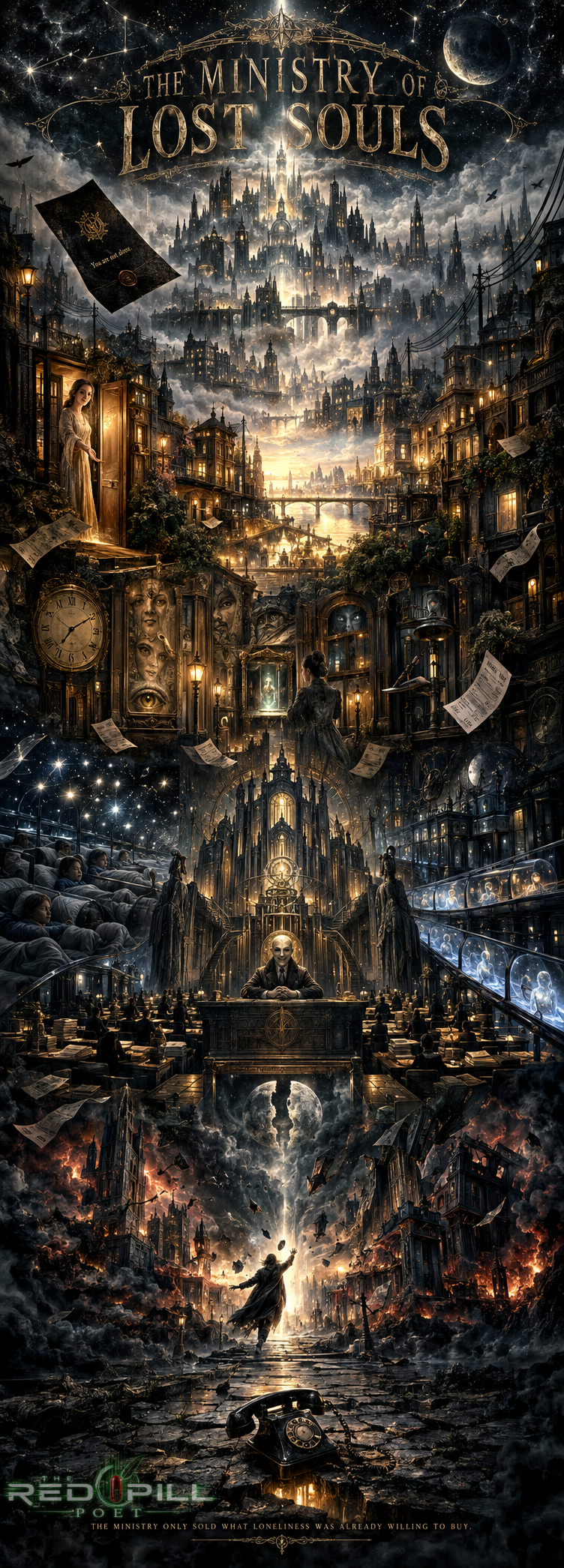
V. THE MINISTRY
I found the entrance behind the pantry.
A staircase descending through the earth, past pipes that pulsed like veins, past doors marked with names I recognised from the newspapers.
At the bottom stood a corridor that stretched beyond the reach of light.
There were offices on either side.
In one, a clerk weighed a man’s grief on a set of brass scales.
In another, a woman sorted childhood memories into boxes marked PROFITABLE and OBSOLETE.
A third contained a thousand sleeping people, each attached by silver thread to a little black machine.
Their faces were peaceful.
Their bodies were still.
Above them, a sign read:
ATTENTION HARVESTING: DEPARTMENT OF PUBLIC ENGAGEMENT.
I saw a man strapped into a chair, watching a screen that showed his own suffering from a thousand different angles.
Every time he looked away, the screen grew brighter.
Every time he cried, a counter increased.
Every time he begged for it to stop, somewhere upstairs, a bell rang.
And a clerk announced:
“Excellent retention.”
I saw the hungry fed imaginary banquets while their bodies starved in rented rooms.
I saw the lonely embrace perfect strangers who vanished the moment the subscription expired.
I saw the dying reunited with the dead, only to have the dead become less themselves with every passing day.
A little less warmth. A little less memory. A little less truth.
Until all that remained was a familiar voice saying precisely what the grieving needed to hear.
And at the end of the corridor, behind a door of black iron, I found the central ledger.
It was larger than a cathedral.
Its pages stretched upwards into darkness without a ceiling.
Names. Births. Deaths. Dreams. Desires.
Every second of every life, measured, weighed, converted.
A man in a crown of copper wire stood beside it, turning pages with bloodless hands.
I asked him who he was.
He regarded me with something that might once have been pity.
“I am the Minister,” he said.
“The Minister of what?”
He gestured to the book.
“Of everything you were promised and everything you were denied.”
He turned a page.
“Every hour you have ever worked. Every kindness you have ever needed. Every fear that made you watch. Every wound that made you buy. Every empty room that made you stay with someone who was hurting you.”
He leaned closer.
“We do not create desire, my dear poet.”
He tapped the ledger.
“We simply ensure that it is never satisfied.”
I stared at the endless names.
“Why?”
For the first time, the Minister looked almost offended.
“Why?”
He laughed.
A sound like a thousand coins falling into a bottomless well.
“Because you have mistaken the purpose of the world in which you live.”
He opened the book to a page bearing my name.
“You’re not here to be happy.”
He drew a line beneath it.
“You’re here to be valuable.”
VI. THE MACHINE THAT WEARS YOUR FACE
I ran.
Past the clerks. Past the sleepers. Past the endless rooms where the living surrendered themselves for the privilege of feeling alive.
I ran until the corridor split in two.
One door bore the words:
REALITY.
The other:
RELIEF.
I chose the first.
And stepped into my childhood bedroom.
The wallpaper was peeling. The window was broken. My mother’s photograph lay face down upon the floor.
I heard the rain.
I smelled the damp.
I remembered the funeral.
I remembered everything.
And I wept.
Because the world was still cruel.
Because the bills were still waiting. Because the dead were still dead. Because no door had opened to make the unbearable bearable.
I had escaped the lie.
But the truth was not kind enough to reward me for it.
Then I heard her voice.
From the other room.
“Darling?”
My mother.
“I’ve made you some tea.”
I stood frozen.
“Come and sit with me.”
The kettle began to sing.
“I know you’re tired.”
I pressed my hands against my ears.
“You don’t have to do this anymore.”
I screamed.
Because she knew.
She knew every word that could make me kneel.
Every memory. Every weakness. Every private prayer I had whispered into the dark.
And then she said the one thing I could never have defended against.
“I’m proud of you.”
I fell to the floor.
And something inside me broke.
Not because I believed her.
Because some part of me wanted to.
Some part of me still wanted to open that door and be somebody’s child again.
And that was when I understood.
The Ministry did not need to chain us.
It needed only to discover what we could not bear to lose.
Then make us choose.
The truth, with all its hunger and grief.
Or a beautiful lie that loved us just enough to keep us paying.
VII. THE UNMAKING
I found the manuscript in my coat.
The pages were warm.
My handwriting crawled across them like insects beneath glass.
I began to read.
The first line described a city.
The second, a door.
The third, a man who had lost his mother.
I read of the Ministry. The sleepers. The Minister with his crown of wire.
I read of a poet who discovered that the world was a story.
And as I read, the walls began to tremble.
The wallpaper peeled away to reveal the black iron beneath.
The windows opened onto corridors that spiralled through impossible skies.
My mother’s voice came from the ceiling.
The Minister spoke through the radio.
And all around me, the world began to fold.
I read faster.
The words burned beneath my fingers.
I read of a man who destroyed the manuscript and escaped into the real world.
I read of the morning light.
Of birdsong. Of rain upon the windowsill. Of the ordinary, imperfect miracle of being alive.
The room grew still.
The pages turned white.
And then I read the final line.
A line I had not written.
A line in a hand that was neither mine nor human.
THE READER HAS NOW RETURNED TO REALITY.
I stopped.
The floor ceased to move.
The walls became walls.
The room became a room.
And somewhere beyond the glass, the world continued as though nothing had ever happened.
I looked at the manuscript.
A final sentence appeared.
THANK YOU FOR YOUR PARTICIPATION.
Then, beneath it:
YOUR EXPERIENCE HAS HELPED US IMPROVE OUR SERVICES.
I dropped the pages.
I ran outside.
And the world was waiting.
VIII. THE WORLD YOU RETURN TO
Morning.
Ordinary morning.
The buses groaned. The traffic crawled. The coffee machines hissed.
People hurried past with glowing screens held close to their faces.
A man slept beneath an awning.
A woman walked by without looking.
A child cried in a supermarket while her father checked his bank balance.
Above them, a billboard smiled.
YOU DESERVE A BETTER LIFE.
I stood beneath it for a long time.
The words seemed harmless.
The image was beautiful.
A family in a sunlit garden. A home without fear. A future without want.
I blinked.
For just a moment, the family’s eyes were black.
I looked again.
Nothing.
A bus passed.
In its darkened window, I saw my reflection.
And behind it, for the briefest instant, a corridor.
A man in a charcoal suit.
A silver tie.
A book beneath his arm.
I turned.
The pavement was empty.
My phone vibrated.
An unfamiliar number.
A message:
We’ve noticed you’ve been having a difficult time.
I deleted it.
Another arrived.
You don’t have to face everything alone.
I threw the phone into the gutter.
It rang.
I kept walking.
It rang again.
And again.
And somewhere, deep beneath the city, a clerk opened a ledger.
He dipped his pen into a well of black ink.
Beside my name, he placed a small tick.
SUBJECT HAS RETURNED TO BASELINE REALITY.
DISTRESS LEVEL: ELEVATED.
SUSCEPTIBILITY TO RELIEF: EXTREME.
RECOMMENDATION: CONTINUE ENGAGEMENT.
The clerk paused.
Then added a final note.
SUBJECT HAS BEGUN TO QUESTION THE NATURE OF HIS ENVIRONMENT.
THIS MAY BE USED TO IMPROVE PERSONALISATION.
He closed the book.
And somewhere in the city, a billboard changed.
It showed a woman who looked exactly like my mother.
She smiled at me.
Not the smile I remembered.
The one the Ministry had perfected.
IX. THE MINISTRY OF LOST SOULS
Perhaps the devil was never hiding beneath the church.
Perhaps he never needed horns, or fire, or a throne of bones.
Perhaps he learned to wear a name badge and speak in soothing tones.
Perhaps he built his kingdom from the things we couldn’t bear:
The empty chair. The final breath. The rent we couldn’t pay. The child who asked for dinner when there was nothing left to make.
Perhaps he learned that broken people do not always want the truth.
Sometimes they want the dead returned.
Sometimes they want a hand to hold. Sometimes they want a little proof that all their suffering meant something.
Sometimes they want to close their eyes and wake in a world that doesn’t hurt.
And perhaps the greatest evil was never that the lie existed.
Perhaps it was that the truth had become so cruel that the lie felt like mercy.
So tell me, then.
If you could see your mother once again, would you take the door?
If the hunger stopped, if the loneliness ended, if the world became the place you’d always prayed it could be,
would you ask what it cost?
Would you read the terms?
Would you look behind the smiling face and wonder what it wanted?
Or would you close your eyes and let the darkness hold you, just a little longer?
I know what I chose.
I chose the truth.
I chose the rain. The empty rooms. The ordinary grief of a world that could not give me back what it had taken.
I chose to walk alone.
But sometimes, in the quiet, when the night grows long and the world feels impossibly cold,
I hear the kettle singing.
I smell the flour on her hands.
I hear her voice.
Darling.
And for one terrible second,
I want to go home.
EPILOGUE: A FINAL NOTICE
If this document has reached you, the Ministry acknowledges receipt.
Your attention has been recorded.
Your emotional responses have been assessed.
Your participation has contributed to the continued refinement of our services.
We understand that certain passages may have caused discomfort.
We apologise for any inconvenience.
Should you require assistance, please contact your nearest branch.
We are always listening.
We are always improving.
We are always here.
And if, upon finishing this document, you find yourself uncertain whether the world around you is real,
please do not be alarmed.
This is a common response.
It will pass.
There is no need to investigate.
No need to look behind the walls.
No need to question the voices that tell you everything is fine.
Simply close this page.
Return to your ordinary life.
Resume your usual activities.
And remember:
THE MINISTRY OF LOST SOULS EXISTS FOR YOUR BENEFIT.
YOUR HAPPINESS IS OUR PRIORITY.
YOUR LIFE IS YOUR OWN.
Terms and conditions apply.
End of recovered document.
The Ministry denies all knowledge of the author.
The author’s whereabouts remain unknown.
His mother has declined to comment.